The Build vs Buy Decision
#1
Many teams assume nodes provide the data their app needs. In reality, nodes only provide raw blockchain data. Applications need enriched, indexed, normalized, and modeled data.

Build In-House
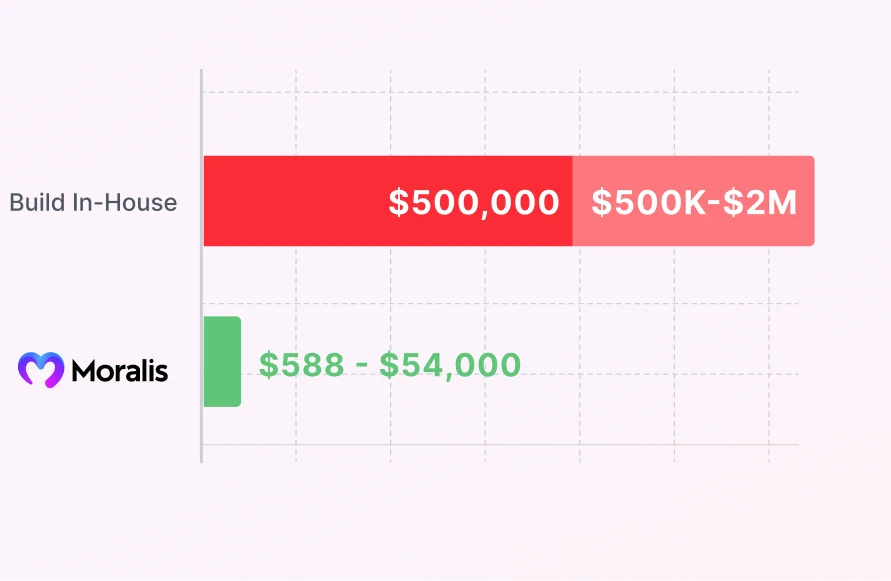
Cost $500K-$2M per year
ADVANTAGES
- Full control and customization
TRADE-OFFS
- 6-12 months to production
- $500K-$2M annual cost
- Constant maintenance

Buy (Moralis)
Cost $3.5K-$54K per year
ADVANTAGES
- Ship in days, not months
- 99.9% uptime SLA
- Production-ready blockchain APIs
- 5-20x cost savings
- Zero maintenance overhead
The gap between raw node data and usable application data is where cost and complexity explode.
Let’s compare Token Balances
#2
Full Token Balances
Are Hard
Full token portfolios aren’t stored anywhere onchain, so there’s no single RPC method you can call to fetch them.
To compute token balances reliably, you must:
- Identify all token contracts a wallet has ever interacted with
- Index all relevant transfer logs (historical + real-time)
- Apply deltas to maintain balance state
- Resolve decimals, name, symbol, contract verification
- Fetch token price & compute USD values
- Detect spam / malicious assets
- Normalize and format output consistently across chains


Native Token Balances
Are Easy
Native balances are stored on the account itself, so they only require one API call.
eth_getBalance(address)
Scaling Across
Chains = Costs Compound
Every chain has different RPC quirks, indexing rules, metadata sources, and ecosystem standards - so supporting a new chain multiplies work rather than adding it linearly.
How to add a chain internally
Adding more chains dramatically increases complexity.
-
$1K-$8K/month for each chain RPC node
Multiplies with redundancy demands
Adapt indexing logic for chain-specific quirks
Token metadata registry upkeep
Test edge cases unique to that chain
-
Monitor & maintain additional infrastructure
Breakage surface grows exponentially
Handle chain-specific reorg patterns


How to add a new chain on Moralis
Change a single query parameter:
- No new infrastructure
- No new code to maintain
- No operational burden
Replicating the entire Moralis Data Layer means building 60+ pipelines.
| Example Endpoints | What Must Be Built Internally | |
|---|---|---|
 Wallet Wallet |
|
Indexing + spam filters + metadata normalization |
 Token Token |
|
Registry + pricing sources + verification |
 Transactions Transactions |
|
Archive nodes + trace indexing + ABI resolution |
 NFTs NFTs |
|
Media caching + rarity computation |
 DeFi DeFi |
|
AMM math + real-time pool state sync |
-
If you build one endpoint,
you've built an integration. -
If you build sixty,
you've built a platform. -
Platforms require entire teams.
Cost Comparison
#3
Building your own data pipelines creates fixed, compounding costs; buying with Moralis converts that into predictable, usage-based cost.
Monthly Operating Cost Reality
| Node only | Build internal indexer | Moralis Data API | |
|---|---|---|---|
| Node hosting | $50K-$100K | $3K-$15K | Included |
| Indexing compute + storage |
— | $1K - $15K | Included |
| Engineering headcount | — | $15K - $35K/mo | Included |
| Metadata + pricing feeds | Manual | $1K - $5K/mo | Included |
| Security + spam detection | — | Must build | Included |
| Cross-chain scaling | Manual & costly | Complexity multiplies | One query param |
| Time to launch | 1 day | 3-18+ months | ~1 hour |
| Typical Monthly Outlay | + hiring + maintenance | scale-dependent |
Total Cost of Ownership (TCO)
Most teams spend more on the first engineer needed to maintain the system than the entire Moralis platform costs for the year.
One blockchain data engineer $120K-$240K /year fully loaded
Annual Moralis subscription starts at $588 /year
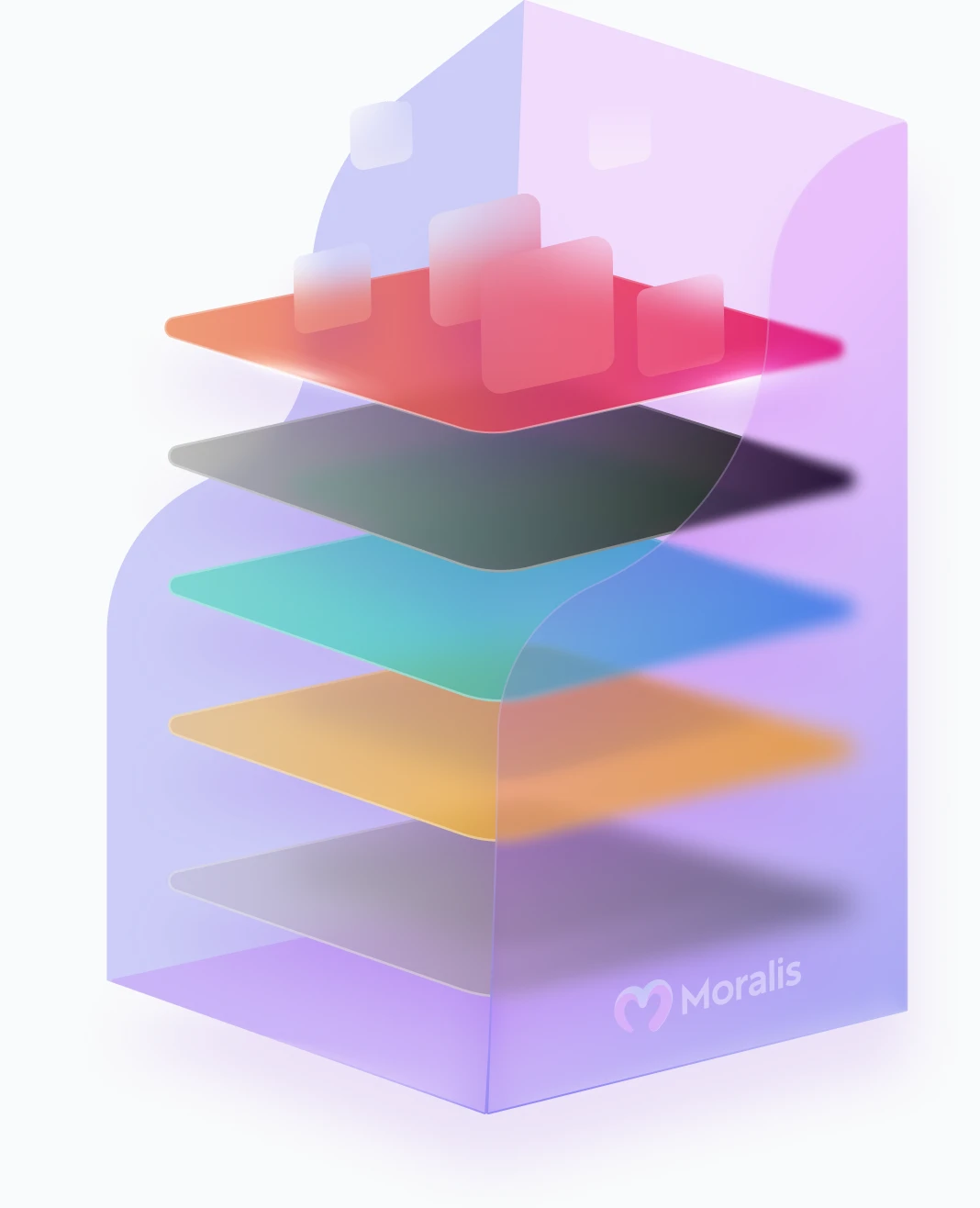
Layered Data Stack
(What You'd Otherwise Have to Build)
#4
Token balances are just one data type. A production-grade data layer requires 60+ specialised data pipelines.
-
Application-Ready Data
(what UI & product teams need)
-
Pricing, Metadata, Spam/Scam Detection
-
Unified Balances & Portfolios Across Chains
-
Indexing (logs, traces, re-org safety, historical sync)
-
Nodes / RPC Access
(Node providers stop here)
Security, Reliability
& Compliance (SOC 2 Type II)
#5
Operating a blockchain data indexing platform isn't just an engineering task - it's a security and compliance responsibility.
Most internal teams under-estimate the ongoing operational and compliance overhead required to keep such a system secure and audit-ready.
Moralis maintains:
| SOC 2 Type II Certification | Active and audited annually | Our internal systems, data handling, access controls, logging, monitoring, and change management are continuously validated by an independent auditor |
|---|---|---|
| Continuous chain data validation | Automated | Detects and corrects chain reorgs, indexing anomalies, metadata drifts |
| No keys, no signing, no custody | Architectural | Zero risk of wallet compromise / asset interaction |


Why this matters in Build vs Buy
If you self-build:
- You must design and maintain access controls
- You must maintain change management procedures
- You must pass (and pay for) security audits annually
- You must create and maintain incident response playbooks
- You require 1-2 dedicated security + compliance engineers
- You must engage with external audit firms at high ongoing cost
If you use Moralis
- We provide the platform already security-certified and continuously audited.
- Your team inherits this assurance - instead of needing to build it.
Time-to-Market
#6
In Web3, timing is everything. First movers capture developer mindshare and ecosystem adoption.
- TIME TO MVP
- 6-12 months
- TIME TO PRODUCTION GRADE
- 12-24+ months
- TIME TO MVP
- ~1 hour
- TIME TO PRODUCTION GRADE
- 1-4 weeks incl. QA
Shipping 6–12 months earlier often determines:
-
Ecosystem adoption
First-mover advantage
-
Market positioning
Category leadership
-
Developer mindshare
Community growth


Conclusion
#6
In Web3, timing is everything. First movers capture developer mindshare and ecosystem adoption.

Nodes are for raw blockchain access.
Moralis is for production-ready blockchain data.
Moralis replaces:
- 1-3 full-time engineers
- Multi-region node infra
- Continuous indexing maintenance
- Metadata & pricing synchronization
- Security / spam filtering logic